Maël A.N.C.
Worshipful Brothers and Sisters…
and all of you, my Brothers and my Sisters, as human beings devoted to PEACE, accompany us towards this inspiration… which raises so many questions among us…
When does an artist know that his work is finished?
This question, simple in appearance, led me to another, far more troubling one: is a work ever truly finished?
The painter can always add a touch. The inspired ruler can always add to it the strength of his democratically acquired power, so that the people may enjoy peace, development and justice…
The writer can always rework a sentence.
The musician can change a note, a silence, a rhythm.
The sculptor can still remove a fragment of material. The ruler can always, at every moment, stand ready to improve the concrete lived experience of the people who elected him; kings by divine right strive to perpetuate rights and duties in full horizontality, justice and Peace.
And yet a moment necessarily comes when the artist must stop.
Not always because the work is perfect, but because he decides that it can now exist without him.
This mysterious boundary between the work in progress and the work surrendered to the gaze of others questions me deeply.
For behind the artist facing his work, I believe I recognise another figure: that of the initiate facing himself.
We too work a material.
That material is ourselves.
And we too must accept this self-evident truth: our work will remain unfinished.
I — Matter and Form
Before the work, there is the material.
For the sculptor, there is wood, stone, marble.
For the painter, the canvas.
For the writer, the blank page.
For the musician, perhaps silence.
And for the decision-maker, republican or royal, there is this rough ashlar symbolically entrusted to him.
When we discover it, it is irregular, imperfect, covered with rough edges.
We quickly understand what is expected of us: to work.
But what does it really mean to work one's stone?
Is it to remove our faults?
To correct our behaviour?
To acquire knowledge?
To learn to listen better?
To understand others better?
To understand ourselves?
No doubt a little of all of these.
But the more I reflect on it, the more a contradiction appears.
If the goal were truly to reach perfection, there would have to be a moment when our work was finished.
A moment when we could look at our stone and declare:
"There. It is finished. I have nothing more to learn about myself."
That single sentence seems absurd.
For whoever thinks he has nothing more to learn may have just revealed one of the greatest rough edges of his stone.
Thus initiatory work contains, from its very origin, a strange contradiction:
we must strive towards an accomplishment that we nonetheless know can never be wholly completed.
The artist knows exactly this tension.
He seeks a perfect form while knowing that this perfection will always elude him.
And it is perhaps precisely this distance between what he imagines and what he manages to achieve that nourishes his desire to continue.
II — The Unfinished Is Not Necessarily the Imperfect
We easily confuse the unfinished with the imperfect.
Yet they are two different notions.
The imperfect implies a judgement.
The unfinished implies a becoming.
An imperfect work would be one that falls short of an ideal.
An unfinished work is one in which something remains possible.
This distinction seems to me essential.
Art history offers us many examples of works whose apparent incompleteness contributes precisely to their power.
In Michelangelo, certain so-called non finito sculptures seem still imprisoned in the block of marble. Bodies emerge, while some parts remain caught in the material.
One might think that something is missing.
But our eye can also grasp exactly the opposite: something is being born.
We are no longer contemplating merely a form.
We are contemplating its emergence.
The work then shows us simultaneously what it is and what it could become.
And that changes everything.
For the unfinished ceases to be a defect.
It becomes a tension.
A movement.
A promise.
Perhaps our rough ashlar should be regarded in the same way.
Not as proof of our imperfection, but as the visible manifestation of our capacity for transformation.
As long as a rough edge remains, work remains possible.
And as long as work remains possible, something remains alive.
III — The Artist Must Know When to Lay Down His Tool — and So Must the President and the King…
But another difficulty arises.
If the work can always be improved, when should one stop?
The artist knows this anguish.
One more touch.
One more correction.
One more detail.
One more reworking.
Until the moment when wanting to perfect the work paradoxically risks destroying it.
One must then know how to lay down the tool.
This idea also seems to me profoundly initiatory.
We talk a great deal about work and about citizen initiatives…
Perhaps we should sometimes talk more about stopping work.
There is a time to strike the stone.
But there is also a time to lay down the mallet.
A time to act.
And a time to look.
A time to speak.
And a time to listen.
A time to seek.
And a time to accept not knowing.
For working on oneself does not mean correcting oneself endlessly until one becomes the prisoner of an unattainable ideal.
Perhaps one must also learn to recognise the form that is already there.
The artist does not necessarily create by adding.
The sculptor, for his part, creates by taking away.
The politician, for his part, can innovate through his speeches and his concrete actions for the supreme interest of our deserving peoples…
And this idea seems to me particularly beautiful for thinking about our path.
Perhaps progressing does not always consist in becoming more.
Perhaps it sometimes consists in taking away.
Taking away a prejudice.
Taking away a certainty.
Taking away a fear.
Taking away an over-hasty judgement.
Taking away that strange need to be right.
Taking away, too, whatever prevents us from truly meeting the other.
And gradually something appears that was perhaps already present, but that we did not know how to see.
IV — Brâncuși: Finishing a Work That Does Not End
There is a work that seems to me to express this paradox admirably: Constantin Brâncuși's Endless Column.
Materially, this column obviously has limits.
It begins somewhere.
It ends somewhere.
Yet through the repetition of its modules, Brâncuși gives us the impression that it could go on.
Again.
And again.
Towards the sky.
The object is finished.
But the idea it carries is not.
The work is therefore at once finite and infinite.
And perhaps the same could be said of initiatory work.
We are finite beings.
Our time is limited.
Our presence in this Temple of life is limited.
Our very existence has a limit that we all know.
But the work in which we take part goes beyond us.
The symbolic Temple we are building did not begin with us.
And it will not end with us.
We are the temporary custodians of a work begun by others and destined to be carried on by others.
This profoundly changes the way we regard our stone, our work…
Perhaps I do not necessarily have to finish it.
I must work it enough for it to find its place in a construction that goes beyond me.
V — The Unfinished as Room Left for the Other
This reflection leads me to an idea that seems to me essential.
What if the unfinished were precisely the room left for the other?
A wholly closed work asks nothing of the one who looks at it.
It asserts.
It imposes.
It concludes.
Conversely, a work that retains a measure of indeterminacy calls on our imagination.
It compels us to enter into it.
To complete.
To interpret.
To question.
The unfinished creates a space.
And this space makes encounter possible, between Arab-African and Western peoples…!
Could we not apply the same idea to the exchanges among ourselves?
When I present my text, for example, is it really finished at the moment I deliver it?
I do not believe so.
At that very instant, on the contrary, something begins.
My reflection leaves the one who built it.
It meets those who listen to it.
Sometimes it wins agreement.
Sometimes disagreement.
Sometimes a question I had never thought of myself.
And it is perhaps at that instant that my text becomes truly divine, in all modesty…
It is no longer only my thought.
It becomes a common material.
Each Brother, each Sister can bring to it his or her own perspective.
Thus the unfinished is no longer a weakness.
It becomes a condition of dialogue, so long hoped for by our peoples in order to perfect equality, peace, justice and the harmonious development of our countries…
To welcome the thought of the other, I must accept that mine is not definitive.
To truly listen, I must accept that there is a space within me that is not yet filled.
To receive, a place must necessarily remain empty.
VI — The Unfinished Palace
We are working to build the Palace.
But what would this Temple be if it were one day definitively finished?
A Temple to which no stone could be added?
A Temple in which nothing could be moved?
A perfectly closed Temple?
Perhaps it would then become a monument.
Magnificent, no doubt.
But motionless.
Yet the initiatory Temple is not a monument.
It is a building site.
We enter it in order to work.
And this idea of the building site seems fundamental to me.
On a building site, not everything is in its place.
There is noise.
Dust.
Tools.
Imperfect stones.
Hesitations.
Errors, sometimes.
Corrections, often.
But above all there is a project.
What gives the building site its meaning, then, is not its present imperfection.
It is the direction in which the builders work together.
Perhaps it is the same with humanity itself.
It is terribly unfinished.
We see this every day.
But recognising this incompleteness does not mean giving up on it.
It means exactly the opposite:
something remains to be built.
VII — What If We Ourselves Were the Work?
But one last question remains.
Since the beginning of this paper, I have spoken of the artist and his work as if they were two distinct realities.
What if this separation were an illusion?
When the artist works at his art for twenty years, is it only his work that is transformed?
He changes too.
His hand becomes more precise.
His eye evolves.
His standards shift.
He discovers his limits.
He sometimes learns to accept them.
While he shapes his work, his work shapes him.
So perhaps it is exactly the same for us.
We believe we are working our stone.
But our stone is working us.
We believe we are building the Temple.
But the Temple is building us.
We believe we are practising a ritual.
But, year after year, perhaps it is the ritual that silently acts upon us.
Then a dizzying question arises:
who is the artist and who is the work?
Are we the builders of the Temple?
Or are we the material from which the Temple is built?
Perhaps we are both.
Conclusion — Laying Down the Tools
Worshipful Master, my Brothers, my Sisters,
At the outset of this reflection, I thought the unfinished simply meant what had not been completed.
Today I wonder whether it does not designate something far more essential:
that which remains alive.
A definitively finished stone no longer calls for any work.
A definitively finished thought no longer tolerates any contradiction.
A definitively closed work no longer leaves any room for the one who contemplates it.
The unfinished would then be the sign not of our inadequacy, but of our capacity to continue.
The artist works the material.
The human being works his stone.
But both perhaps end up discovering that, while they believed they were transforming the material, the material was also transforming them.
So I look differently at this rough ashlar that has been entrusted to me.
I no longer necessarily seek to know when it will be finished.
I seek to know whether each blow struck makes it a little more just.
A little more conscious.
A little more free.
And above all, a little more fit to join the other stones.
For perhaps we are not here to finish the Temple.
We are here to continue it.
And when the day comes to lay down our tools for good, there will certainly remain a rough edge on our stone.
An unanswered question.
A word we will not have spoken.
A work to be carried on.
Then perhaps our true accomplishment will not be to have finished everything.
It will be to have worked enough to allow others to continue after us.
The artist leaves his work.
The builder leaves his stone.
The initiate leaves a trace.
And the unfinished then becomes no longer a void, but an invitation.
A place left for the other.
A door left open, MARHABABIKOOM…!
A work still waiting for a hand.
Perhaps this, in the end, is the hallmark of every true work:
to be finished enough to be handed on,
and unfinished enough to go on living, INCHAALLAH…!
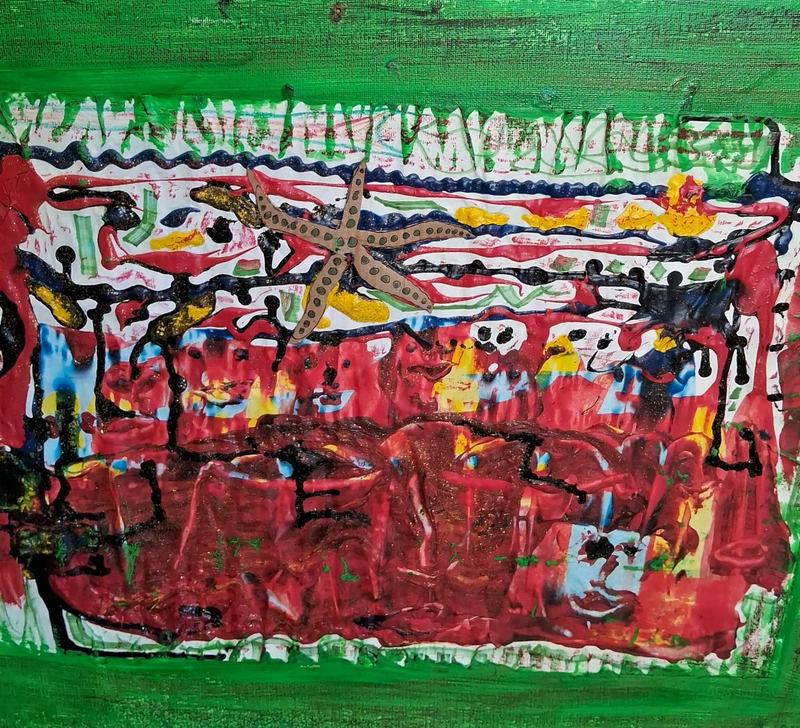
GAZA-IN GAZA-OUT..!
When this canvas was presented in a Parisian gallery, a viewer, frowning, asked me: "Did you make this canvas?" My answer was immediate: "No, it was not me, but those who have crushed universal humanitarian law…!"
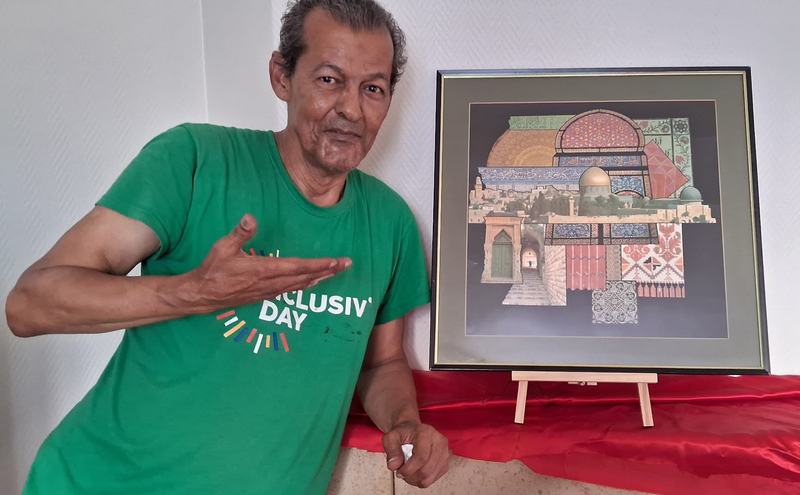
This work was first shown at an event initiated by the president of the association ASLI, Seyda Moona Bennany, a great lady of the Moroccan diaspora in Paris. The event was filmed by the Moroccan television channel 2M, and in it I give a short interview presenting my canvas, which is in fact inspired by the role of the KING, His Majesty MOHAMMED VI, President of the committee for the protection of the Islamic heritage of AL QODS in JERUSALEM. This canvas is reserved for His Majesty, from my humble self, a cousin, Chérif Semlaly, until I can present it to him in person.
It is thus a symphony of artistic and cultural diplomacy, between brothers and neighbours — blessed be it…!
Mohamed Mael Aïnine Nema cherif SIDI ETHMANE